Thursday, 4 February 2010

'David Live' by David Bowie

When Bowie toured Ziggy, he was accompanied by four people – a guitarist, a bassist, a drummer, and a pianist. By the time he was taking the Diamond Dogs tour across America, he was heading a band of eleven. As a result, the live album of the tour is, in parts, busier, fuller, more bloated, and messier than earlier live recordings.

The bulk of the album is material taken from ‘Diamond Dogs’ and ‘Aladdin Sane’, Bowie’s most recent two albums (sensibly discounting ‘Pin-Ups’). This is the material that works best. ‘1984’ makes for an excellent start, and ‘Sweet Thing’ and ‘Big Brother’ sound fantastic. The title track from ‘Aladdin Sane’ is successfully reworked for the stage, and ‘Time’ and ‘Watch That Man’ both benefit from the additional musicians.

Older songs are more of a mixed bag. ‘Suffragette City’ works well as a riot of noise, and ‘Space Oddity’ makes the transition well, but ‘The Width Of The Circle’ sounds more bloated than usual (and it’s bloated enough in the first place), and ‘Rock ‘n’ Roll Suicide’ is drained of its power by too much woodwind making it something of an anti-climax.

Most interesting are the two cover tracks. ‘Knock On Wood’ is reasonably disposable, but it carries a good sense of fun. ‘Here Today, Gone Tomorrow’ is something a departure – a more soul-influenced song which is the only real indication up to this point of the ‘Young Americans’ sound that was to come. As the tour progressed, these influences would apparently play a much more significant role, and it’s a shame, retrospectively, that the album wasn’t recorded during this later period.

As a result, this album can’t claim to be essential, or even mildly important, but it’s a decent enough listen with some good moments.

Wednesday, 3 February 2010

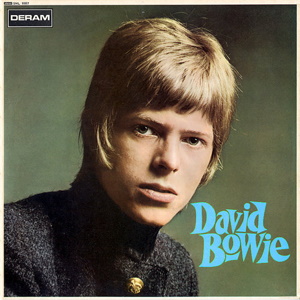
''David Bowie' by David Bowie

There are good reasons for quietly disowning a debut album later in your career. Perhaps it’s clearly inferior to the rest of your work, or perhaps it’s just too stylistically different from later albums to make sense of. Neither of these reasons really explains the status of ‘David Bowie’, however. For many years, Bowie’s quasi-official discography has had ‘Space Oddity’ at the beginning, and ‘David Bowie’, the album that came first, has been largely overlooked.

In terms of quality and style, it’s a mixed bag. Some if it is genuinely very good, other bits, less so. ‘Uncle Arthur’ and ‘Little Bombadier’ are the sort of character study that Blur would go on to forge a career with, and its lots of fun, but a bit twee.

‘Sell Me A Coat’ has a lovely arrangement and melody, especially in its verses. ‘Love You Til Tuesday’ is a fantastic sixties-style gem (though close to being ruined by the last few seconds). ‘When I Live My Dream’ is a bit schmaltzy, but it works.

‘Rubber Band’ mixes unconventional arrangements with bizarre lyrics, but generally remain interesting, and fairly good. ‘We Are Hungry Men’ is a slightly deranged pointer in the direction of ‘Hunky Dory’ and, in a sense, ‘Diamond Dogs’. ‘Please Mr Gravedigger’ is possibly the oddest album closer in the Bowie catalogue – unsettling, off-key, barely even a song, it’s a difficult lesson, and a key indication of Bowie’s determination to follow his own path.

At times, the affectations of the album veer towards irritating, and it may not have dated amazingly well, but there’s plenty to enjoy here. It’s certainly more interesting than ‘Space Oddity’, even if it has nothing to match the quality of that album’s title track, and although there was a jump of styles between those two albums, the jump between ‘Space Oddity’ and ‘The Man Who Sold The World’ was bigger still. On the plus side, because of its relegation to ‘largely forgotten status’, this album can be picked up cheaply and easily.

Tuesday, 2 February 2010

'Dark Side Of The Moon' by Pink Floyd

What took me so long to hear this? Despite this album being nestled among mum and dad's vinyl collection throughout my life, I only actually listened to it for the first time two or three years ago. For the life of me, I can't remember what made me investigate it further.

It's brilliant, of course. Rarely does any album work so well as one consistent piece of work - every part of every track fits into sequence perfectly. Rarely also do a band work together so closely to produce such a unified sound. It's hard to understand how a band that could make this album could become so acrimonious.

Highlights are hard to pick out due to the nature of the album, but there are some - the harmonies in 'Time', the piano intro to 'The Great Gig In The Sky', all of 'Us And Them'. To be honest though, the highlights are joined together by other highlights - this album doesn't put a foot wrong. Essential.

Friday, 29 January 2010

'Dark On Fire' by Turin Brakes

Funny one, this. 'Dark On Fire' is one of those albums that just won't work its way into my conciousness, however many chances I give it. It made little impression on me when it came out, and I've returned to it several times since, enjoying it each time, but for some reason, it just won't stick.

I like it, though. Lots of it is really good - 'Stalker', 'Something In My Eye', the title track (even if it does sound like 'Dog On Fire') are all great, and there are no particular weak spots. It just doesn't have enough distintiveness to sound out. I'm all for bands trying new approaches, so it seems harsh to criticise them for recording an album with a more 'live band' approach, but the downside is that they sound like a band rather than a duo quite a lot of the time. That isn't a bad thing in itself, but you get less of the harmonies, and less of the delicate nature of previous Turin Brakes albums.


I spent a couple of days listening to this album fairly solidly, and I did enjoy it. A couple of days on, and I find it hard to recall many of the tracks very clearly. However, I'll come back to it again - and eventually, I'll crack it.

Thursday, 28 January 2010

‘Dangerous People’ by Noel Richards

I hadn’t listened to a Noel Richards album for many years – probably a decade – until I listened to ‘Calling All Nations’ a couple of weeks ago. I knew then that this was coming up, and it bothered me. It bothered me because I’d found ‘Calling All Nations’ such hard work, but I didn’t want that to be true for ‘Dangerous People’, as I was pretty fond of Noel Richards’ music back when this was released.

Happily, this remains a much better album than the one that followed it. It’s a little dated now, perhaps inevitably, and it’s welded so strongly to it’s stadium worship context that it’s difficult to comprehend it in any other setting, but it still has proper tunes, and an energy that ‘Calling All Nations’ was entirely lacking.

Interestingly, the album works best at either end of a scale. The most obviously ‘built-for-stadium’ tracks work well (‘Love Songs From Heaven’, ‘Keep On Praying’, ‘There Is No-one Like Our God’), though the lyrics don’t stand up to a great deal of scrutiny, presumably as they were designed to be sung in large groups and therefore accessible to all. At the other end of the scale is ‘You Are My Passion’, a mostly acoustic track which serves as a reminder of how effective a songwriter Richards can be when stripped of all the bluster – the Richards who wrote ‘By Your Side’ and ‘You Laid Aside Your Majesty’. The weak points of the album are where it falls between the two ends of the scale – ‘I Do Believe’, and ‘Have You Heard The Good News?’ (a song written by Stuart Garrard of Delirious who served a stint in the Noel Richards band) aren’t bad, but are reasonably unremarkable. Still, these are minor quibbles for an album which holds its own pretty well.

‘Daisies Of The Galaxy’ by Eels

If emotion can be charted on a graph, there was only one direction that ‘Daisies of the Galaxy’ could go, following the ultra-bleak ‘Electro-Shock Blues’. It’s a testament to Mark Everett’s misery that this album was, and arguably still remains, the most upbeat and cheerful record in the Eels back catalogue. Some of it genuinely sounds happy – ‘Grace Kelly Blues’, ‘I Like Birds’ and ‘Tiger In My Tank’ all sound like they were sung with a smile – but much of it is either still run through with a sense of melancholy (‘Jeannie’s Diary’), or an unsettling sense of peculiarity (‘Flyswatter’, ‘The Sound of Fear’). Even amongst the relative cheeriness, Everett still manages to squeeze in track 7. So, despite being the happiest Eels album in existence, it’s an album you’re unlikely to reach for if you want cheering up.

Never-the-less, ‘Daisies of the Galaxy’ is a lovely album. Instrumentally, it’s gentler than ‘Beautiful Freak’, more accessible than ‘Electro-Shock Blues’, and much easier to listen to than ‘Souljacker’, the album that came next. Awash with acoustic instruments and piano, it would make very pleasant background music if it wasn’t for vocals which demand your attention. Even at his most commercially pleasing, Everett refuses to make any kind of music other than exactly what he wants to make, and as usual, he should be applauded for this.

‘d:tour 1997 live’ by Delirious?

By a quirk of alphabetical organisation, we come to this immediately after the four Cutting Edge albums, but miss out ‘King of Fools’, the anchoring album that ties this record to them. Ah well.

Once the Cutting Edge band had changed their name to Delirious and decided to go full time, lots of things happened. All of a sudden, there was a full album, singles, a tour of proper venues, even TV appearances. The first phase of their new lives was concluded with this, a recording from a date on the tour, released, if memory serves, through mail order? I may be making that up.

As it stands, it’s certainly a good document of how things were at the time. Most of ‘King of Fools’ is represented here, as well as a handful of later Cutting Edge tracks. At the time, the tracklisting was a mild disappointment –the ‘King of Fools’ tracks were pretty much as recorded, and the rest had been recently released on the ‘Live and in the Can’ collection, but separated from this context, everything sounds pretty good. The between-song banter from Martin Smith is mildly awkward at points, but full of optimism for the future which proved to be fairly well founded – Delirious would certainly go from strength to strength over the years, though not always in the way they had planned or expected.

Thirteen years later, it’s hard to regard this album as essential. It isn’t – but it does remain a decent listen, and it retains a nostalgic glow for anyone caught up in their trajectory at the time.