Showing posts with label Radiohead. Show all posts

Wednesday, 7 December 2011

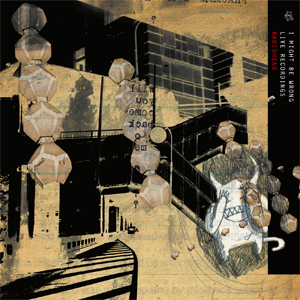
‘I Might Be Wrong - Live Recordings’ by Radiohead

It’s difficult to see the purpose of this record. A live album? A ‘rounding up’ of the ‘Kid A’ / ‘Amnesiac’ era? An opportunity to show how tracks from these two albums worked in a live context? In some ways, it’s all of these things – in other ways, it’s none of them.

It’s too short to work as a convincing live album. In fairness, it was released and priced as a mini-album, so that’s perhaps an unfair criticism, but it seemed (and still seems) a waster opportunity – a few earlier tracks would have made welcome additions. Does it round off the era? I guess so, though you could say the same about ‘Hail To The Thief’, which arguably does the job a little better. So, an opportunity. Would Radiohead really have wanted to prove themselves like this? It flies in the face of the more self-consciously difficult approach they’d been working with. And, to be fair, it doesn’t take a great deal of imagination to listen to the studio versions of ‘Idioteque’ or ‘Morning Bell’, say, and not see how they would work on stage.

Three tracks, though, make this worthwhile. ‘Like Spinning Plates’ is the most radical departure from the album version, replacing the programmed backing track with a simple circular piano accompaniment to great effect. ‘Everything In Its Right Place’ starts in the same place as the ‘Kid A’ version, but mutates into a pulsing beast of a track. ‘True Love Waits’, the closing track, is the albums main draw – the only track not available elsewhere. It’s radically different to the rest of the album: a solo performance on Thom Yorke’s acoustic guitar, but it’s a thing of beauty.

The album as a whole – decent enough, but a footnote, really.

Sunday, 9 October 2011

'Hail To The Thief' by Radiohead

What a pleasure it is to listen back to an album you’ve not heard for a while, and find it’s as good as you remember, if not better. In the history of Radiohead, ‘Hail To The Thief’ is liable to be a bit overlooked, sandwiched as it is between the ‘Kid A’-‘Amnesiac’ double act and the pay-what-you-like ‘In Rainbows’. It shouldn’t be overlooked – it’s worth more than that.

The album, I think, was the point at which Radiohead managed to comfortably straddle the line between their rock band origin and the experimental electronic identity they’d been cultivating. You wouldn’t know it from the singles – ‘There There’, ‘Go To Sleep’ and ‘2+2=5’ are all pretty traditional to be honest, but there’s a lot going on across the rest of the album. Despite this, it hangs together as a cohesive work very well, and it maintains a pretty consistent quality. After the riotous opening of ‘2+2=5’, ‘Sit Down Stand Up’ builds from a cautious beginning into a brief but effective piece of dance music. ‘Sail To The Moon’ is a textbook Thom Yorke piano led ballad, and so the album continues, touching all the bases nicely. There’s a great sense of attention to detail within the album as well – favourite moments include the break before the second chorus of ‘Backdrifts’, the additional 2 beat bar halfway through verse one of ‘Where I End And You Begin’, the exceptionally dischordant harmonies that begin ‘A Punchup At A Wedding’ and the vocal delivery of ‘Wolf at the Door’.

There are a couple of weaker spots. ‘The Gloaming’, despite being a pivotal part of the album, doesn’t do a lot for me, and ‘Scatterbrain’ is easily skippable, but neither song is bad, and they’re certainly made up for by their surroundings. Wonderful, all in all.

Sunday, 28 February 2010

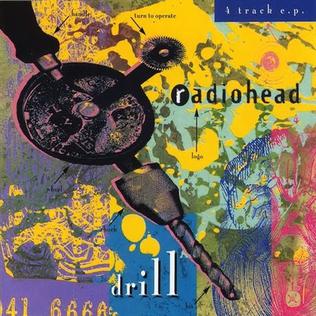
'Drill EP' by Radiohead

Pre-dating their debut album by a year, the 'Drill EP' was the first opportunity to listen to Radiohead ever presented to the world at large. The world at large wasn't especially bothered, and looking back with eighteen year's hind-sight, it's easy to see why. It's not a bad record, but it contains little indication of just how brilliant Radiohead were eventually going to be.

There are four tracks here in all, none of which are of much interest to anyone except die-hard fans of the band. 'Prove Yourself' and 'You' would go on to be re-recorded and tightened up for 'Pablo Honey'. 'Thinking About You' would be re-worked more radically. It would eventually become a gentle moment on the debut album - an acoustic interlude amongst the indie-rock. Here, it's a pretty straightforward race to a finish. The final track (not that it comes at the end) is 'Stupid Cars'. It should be the most interesting track on the record, being the only one to never re-appear in any form, but it's actually pretty forgettable. The band would revisit this subject with the far superior 'Killer Cars', but even this wouldn't be good enough to make it as an album track.


So it's okay. As part of the Radiohead back catalogue, it's worth a listen, but if they hadn't gone on to create so many better records, this would be an unremembered footnote to musical history.

Friday, 13 November 2009

'Amnesiac' by Radiohead

Finally, some Radiohead. And while 'Amnesiac' might not come top of my list of Radiohead albums to listen to, it's still nice to come across it. I remember being very excited about the release of 'Amnesiac', having waited so long for 'Kid A', the previous album, and in fairness, when it was released, I loved it. It was only later that it fell from favour a little, and I hadn't listened to it as a whole album for quite some time.

Devoid of its context, it holds its own pretty well. In fact, it has some real strengths. Almost every track, in its own right, is a good one. As with all Radiohead's work at that time (and now, really), it ranges from the accessible to the downright hard work, but there are things to enjoy across the spectrum. The most accessible points to this album are, I guess, the singles: 'Knives Out', and 'Pyramid Song' (the Top Of The Pops performace of which is one of the funniest things I've ever seen on television). The most difficult track is 'Pul/Pull Revolving Doors' which consists of a programmed drumbeat, a melody-free and heavily treated vocal line, and the occasional piano burble. It's more of an experiment than a song, but it's very atmospheric.

In between, there are all sorts of interesting moments. 'You And Whose Army?' is a highlight for me. It's the fourth track of the album, but the first one to really show off Yorke's voice, and it's a textbook example of how to start a song with nothing, and finish at a crescendo. 'Life In A Glasshouse', the final track, featuring Humphrey Littleton and friends on brass is also magnificent.

Despite all this, the album doesn't hang together in the way 'Kid A' does, and it does feel slightly like a rounded up collection of left-over tracks, somehow adding up to less than the sum of its parts. If it had been released before 'Kid A', it would probably now be viewed as a landmark record, but it's destined to sit always in the shadows, and it doesn't really deserve to.