Showing posts with label The Divine Comedy. Show all posts

Monday, 29 March 2010

'Fin de Siècle' by The Divine Comedy

Only a few days ago, I listened to The Divine Comedy’s ‘Fanfare Of The Comic News’. ‘Fin De Siecle’ couldn’t be any more different. Album number six was written recorded when the band were at their commercial peak. They weren’t house-hold names, but they’d had a run of modest hits singles, and a couple of albums that had sold reasonably well. As a result, the budget for this album was higher, and the ambition was wider. It was the first album by the band that I ever bought, so it holds a special significance to me, though having said that, as I worked my way through the rest of the band’s back catalogue, it slipped very much down the list of my favourites. As such, it’s been a while since I properly listened to it.

Interestingly, although the album is very familiar, it sounds surprisingly different from the image I had in my head. I remember the album as being quite dark, almost oppressive. There is truth in that – the arrangements throughout the album are a touch excessive, and there is a great deal of angst throughout many of the lyrics, but there’s also a great deal of humour, even in the depths.

Commercially, this album came close to breaking the band into a new level of success. ‘Generation Sex’, the first single, did pretty well, and at around the time of its release, the band were given a support slot for Robbie Williams, exposing them to huge audiences. Second single, ‘The Certainty of Chance’ was almost certainly a massive own goal. It’s a great track if you’ve listened to the album build up to it, but it was never going to fit on the radio and be a hit. The third single, ‘National Express’ was their biggest hit to date, and it’s probably still the song most associated with the band, but leaving it until third single meant there was nothing to follow it with, and the momentum died away. There are lots of other great songs – the pounding ‘Thrillseeker’, the mournful but rather lovely ‘Commuter Love’, the delicate ‘Life On Earth’, and the soaring climax of ‘Sunrise’ all spring to mind.

The most unusual tracks deserve a special mention to. ‘Here Comes The Flood’ is a track from a musical that doesn’t exist. Here, Hannon pulls out all the stops – a full orchestra, a choir (two choirs?), explosions, and narration by Dexter Fletcher. It’s as if he knew he’d never have the money to do something like this ever again. The result is a beast of a track – difficult to relate to, almost impossible to play live, yet brilliant in its own way. Tucked away in the middle of the album is ‘Eric The Gardener’, an odd lyric set to a simple five-four pattern which builds into a swooning mix of strings and electronica. It’s the longest track on the album, and the most divisive amongst fans of the band, but it’s really rather lovely.

I went back through the catalogue after buying this album, and ‘Fin de Siecle’ stopped being my favourite. I stand by this change of mind, but this is a great record, and a clear reminder of why I started to love the band so much in the first place.

Thursday, 25 March 2010

‘Fanfare For The Comic Muse’ by The Divine Comedy

Long before The Divine Comedy achieved any kind of success, they released ‘Fanfare For The Comic Muse’. Not only is this their debut album, it is a complete anomaly in terms of their back catalogue, recorded when the band was a three piece. Neil Hannon would start from scratch after this, recording on his own, then eventually building a band around him.

As a result of this historical manoeuvring, ‘Fanfare’ is more or less disowned by Hannon now, and it’s easy to hear why. It’s not that great. It’s a much rougher affair than anything which would follow, and it lacks both the subtlety and flair that ‘Liberation’ and then ‘Promenade’ would have.

Despite that, it has some worthwhile elements. Even at this stage, Hannon’s talents as both a lyricist and composer are starting to emerge. Though there are no classics on this album, there are a number of tracks that indicate that better things were to follow. And so there were.

Thursday, 11 March 2010

‘Europop EP’ by The Divine Comedy

The Divine Comedy have a new album out in May, and the official press release regards it as their tenth. This is interesting – count back ten, and you are lost in the murky pre-history of the band in their pre-‘Liberation’ days. Album one would be the long deleted and largely ignored ‘Fanfare of the Comic Muse’, an album which Neil Hannon has done all he can to disown.

This EP comes from the slightly odd period between ‘Fanfare’ and ‘Liberation’, the second of two such records. It’s main point of interest is in the line up. For reasons best known to himself, Hannon stepped back from being front-man for this release, choosing to act as songwriter, musician and shadowy-backing-vocalist. Lead vocals on the ‘Europop EP’ were sung by John Allen, a man destined to be the smallest of footnotes in musical history. He’s not a terrible vocalist, though if someone told you he was, you probably wouldn’t bother to argue the case, but he adds little value. Hannon, of course, has a tremendous voice, and though it was still developing at this point, even his ‘Fanfare’ vocals were far better than this. As for the material, the songs on ‘Europop’ all sound like they were axed from ‘Fanfare’ for not being good enough, and ‘Fanfare isn’t that great. The early-REM influences are very much on display here, but there’s little in the way of quality. Of most interest, naturally, is the title track, which would go on to be re-recorded for ‘Liberation’. It’s an interesting listen from a historic point of view, and it’s intriguing to see how some of the more familiar arrangements were already in place – the backing vocals and the organ part in the bridge would be virtually unchanged in later versions, though the vocal delivery would be dramatically different, and the ‘Liberation’ ending is missing entirely, presumably unwritten at this point.

In all, the ‘Europop’ EP was a step backwards, not forwards. ‘Fanfare’ showed some promise, this doesn’t. Hannon’s decision to ditch the band and go it alone may have seemed harsh at the time, but there was no future in this. As such, it’s the only Divine Comedy record that can genuinely be regarded as rubbish, and it certainly isn’t worth tracking down for the ludicrous prices it now fetches on the second hand market. A curio, nothing more.

Wednesday, 20 January 2010

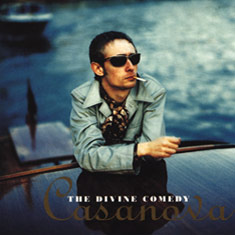
'Casanova' by The Divine Comedy

‘Casanova’ was Neil Hannon’s breakthrough album. For a few short years, the Divine Comedy became a vaguely famous band, and though ‘Fin de Siecle’ and ‘A Secret History’ maintained the momentum, ‘Casanova’ is responsible.

It’s also a remarkably confident album. Despite having two very low selling albums behind him at that point, Hannon sings like a star from the word go. ‘Something For The Weekend’, the song that would be his first hit single, is bold, overstated, slightly daft, and still rather wonderful a decade and a half later. Starting the album with this track, and then ‘Becoming More Like Alfie’ contrasts with his earlier albums which tended to build up a little more slowly. ‘Middle Class Heroes’ slows things down a little, but builds up the layers of orchestration wonderfully. ‘In and Out of Paris and London’ and ‘Charge’ are both wildly overblown chucks of innuendo, but tremendous fun, with ‘Charge’ in particular showing Hannon’s remarkable vocal range stretched to its limit. ‘Songs of Love’ is a perfectly placed moment of calm before the well formed stories of ‘The Frog Princess’ and ‘Woman of the World’.

‘Through A Long And Sleepless Night’ is both the climax of the album and it’s dark heart. It’s an intense rambling epic of a track, and another opportunity for Hannon to show what he can do with a bigger budget. ‘Theme From Casanova’ is slightly throwaway, but it provides a useful buffer between the previous track and ‘The Dogs and the Horses’ which plays out like the final song of a musical that hasn’t been written.

You could hate this album, easily. If you did, you’d criticise it for being excessive, overblown, pretentious, even absurd, and to be honest, it is all of those things. It’s also wonderful, and a fine example of why Neil Hannon is a talent to be treasured.

Friday, 23 October 2009

'Absent Friends' by The Divine Comedy

‘Absent Friends’ was released during what must have been an unsettling time for Neil Hannon. Regeneration, the album for new label EMI, had sold an unspectacular number of copies, and he’d recently said goodbye to his entire band, some of whom had been around for a number of years. Little wonder, then, that ‘Absent Friends’ is a slightly melancholic album. Even upbeat songs, like the title track have something of a sting in the tale – “happy days, we thought that they would never end – but they always end.”

Because Hannon writes in character so often, it’s difficult to make assumptions, but there are plenty of clues throughout the album that Hannon is writing more personally on this record. ‘Absent Friends’ is surely a nod to the band members he’d recently lost, and it wouldn’t be unreasonable to suggest that ‘Sticks And Stones’ may be a comment on the fan reception of the previous album. ‘Leaving Today’ speaks for itself, as does ‘Charmed Life’. It’s unusual to see so much of Hannon himself in his work.

Musically, ‘Absent Friends’ gave Hannon the chance to spread his wings a little after the musical restrictions of ‘Regeneration’. The title track, and opener, revels in its orchestrations, as do the two songs that follow. ‘Sticks And Stones’ has a fantastic accordion line courtesy of Yann Tiersen, though the chorus lets it down a little. ‘Leaving Today’ and ‘Our Mutual Friend’ are as sumptuous as anything in his career. There are only a few simpler moments – ‘Come Home Billy Bird’ is a relatively straightforward indie-ish track, and ‘My Imaginary Friend’ is the most stripped back – and also the most light hearted.

As an album, it has real strengths, and however much I loved ‘Regeneration’, it was good to hear Hannon returning to form when it was released. However, it does lack the humour common in most of his other albums – understandable under the circumstances, but a shame never-the-less. As a result of this, ‘Absent Friends’ feels a little less than the sum of its parts, but as its parts are so good, it gets away with it.

Thursday, 15 October 2009

‘A Short Album About Love’ by The Divine Comedy

Here’s an album I’ve not properly listened to for a long time. It’s only half an album, really, recorded with a budget-busting orchestra between Casanova and Fin de Siecle, so if I’ve wanted to listen to a Divine Comedy album throughout the years, this has tended to be very low down the list. That said, Divine Comedy fandom often rates this as a career high for Hannon, so it’s worthy of re-appraisal.

It starts magnificently, no question. ‘In Pursuit Of Happiness’ starts small but becomes huge as the Brunei Ensemble pour layer after layer of orchestration over what’s actually a pretty simple tune. Every time a new set of instruments plays, Hannon’s voice swells in grandeur and volume before eventually, the whole song crashes back down to a guitar-only ending. This leads into the far more conventional ‘Everybody Knows’, the albums only single. It’s a nice enough track, but it doesn’t make full use of the orchestration available. ‘Someone’ and ‘If…’ follow. They’re the dense core of the album, full of strings and horns, but a little lacking in joy. I know a lot of people rate ‘If…’ as their favourite Divine Comedy song, but I’ve personally never really taken to it. ‘If I Were You (I’d Be Through With Me)’ has a lighter touch which serves it well. ‘Timewatch’ is essentially a bigger replica of the version released on ‘Liberation’. The key has changed, it’s slowed down slightly, and the sting section is larger, but there are no radical differences. ‘I’m All You Need’ closes the album with the most upbeat track since the first two. It’s actually very simple in terms of structure and lyrics, but it’s soul-lifting stuff, especially the instrumental section. The part where the horns join the strings is one of the great moments in the Divine Comedy back catalogue.

It’s tempting to wonder what would have happened if a full album had been done like this. I imagine it could have filled out nicely, diluting the sombre air which the middle of the album has. The b-sides that were released alongside this album would indicate so – we’ll come to those another time. That said, it could have collapsed under its own weight. Certainly the next album, ‘Fin de Siecle’ threatened to do both of these things at the same time. This still isn’t my favourite Divine Comedy record by a long shot, but it’s worth listening to, and it has some great moments, and you can’t say that about every album.

Thursday, 8 October 2009

'A Promenade Companion' by The Divine Comedy

Again, not an album, but a four track EP that accompanies one. This EP came free with early copies of Promenade, though I think my copy was a download in the days when Napster ruled the internet. It's not an essential part of the back catalogue - all the songs appear elsewhere in different guises - but it's a nice addition.

Recorded live (by the sounds of it) by Neil Hannon, a cellist and a violinist, this EP contains one track from 'Promenade', the parent album, and three from the previous one, 'Liberation'.


'Don't Look Down' and 'Your Daddy's Car' are straightforward interpretations of their orginal versions, but with less instruments. 'Queen Of The South' is the highlight, re-imagining the original track as a far more emotional display. 'I Was Born Yesterday' is played somewhat oddly - as if Hannon has recieved a new voice for Christmas, and is learning how it works. Good stuff, though.