Wednesday, 30 November 2011

‘I Just Wasn’t Made For These Times’ by Brian Wilson


A record which is as confusing, as baffling, and as hard to explain as the man who made it. ‘I Just Wasn’t Made For These Times’ was made in the mid 90s as the soundtrack to a documentary about Wilson’s life. As such, there are a number of things about it which are commendable.

Firstly, it would have been easy not to bother. A lazily assembled compilation of existing Beach Boys tracks would have been easier to put together, so it’s good that this wasn’t done. Secondly, it would also have been easy for Wilson to churn out an obvious set of re-recorded ‘classics’. This would have made for a more appealing commercial prospect, but not a better record. Instead, this record skirts around the edges of Wilson’s song-writing catalogue, touching on tracks that are easy to miss – ‘Meant For You’, ‘This Whole World’, ‘Let The Wind Blow’ and ‘Til I Die’ are particularly good choices. Less worthy of inclusion are ‘Love And Mercy’ and ‘Melt Away’, two solo-era tracks credited to Wilson and his doctor/therapist/manager, Eugene Landy, the man who broke Wilson’s drug dependence and began restoring him to a normal life, in return for the minor concession of having complete control over every aspect of his life, and the right to profit from any work he went on to complete – behaviour which resulted in complicated legal action and an eventual revocation of his license to practice. ‘Love And Mercy’ is a pleasant enough track – ‘Melt Away’ is weaker. Perhaps the most interesting track on the album is ‘Still I Dream Of It’, a home demo from the mid-seventies which, I think, had been unreleased until this point.

Alongside the creditable aspects of this work are some fairly major drawbacks. Of course, more work has gone into this album than a simple round-up of the relevant Beach Boys tracks would have been. Unfortunately, that hasn’t resulted in a better album. Wilson’s backing band and singers on this project are a collection of anonymous session players who lack both the family-honed warmth of the Beach Boys or the faithful recreation of Wilson’s later backing band. Worse still, Wilson’s voice is not in good shape here. No-one would expect it to be as good as it was in the sixties, but here it’s in a very fragile condition – a world away from what it would recover to by the time he started touring ‘Pet Sounds’ and recreating ‘Smile’.

So, all in all, this is something of a non-essential record – one for the dedicated fans only. But consider this – this was the first time Wilson had really had the confidence to look back over his life’s work and do something with it. A few years on, and he’d be playing ‘Pet Sounds’ to audiences across the world. A few years later, he finished ‘Smile’. Maybe this was a first step? If so, worth it.

Monday, 28 November 2011

‘Hunky Dory’ by David Bowie

My earliest experience of Bowie – and, I guess, one of my formative musical experiences – was listening to a compilation album called ‘Changesbowie’. This record began with ‘Space Oddity’, and continued with ‘Changes’, the track which opens ‘Hunky Dory’, Bowie’s first great album. I remember loving the track then, and I still love it now. It’s a perfect blend of ingredients. Bowie’s vocals croon through the verses then soar through the chorus, that classic bass-and-guitar riff between chorus and verse hits you every time, and Rick Wakeman’s reverb-y piano is an unalloyed delight. And so it continues. ‘Oh! You Pretty Things’ works in a similar vein. ‘Eight Line Poem’ is too brief and simple to be a favourite, but it’s a sweet addition. ‘Life On Mars’ is exceptional – genuinely, I don’t have the words to describe how good it is: the voice, the strings, the piano, the guitar solo – it couldn’t be improved. ‘Kooks’ is the ideal gentle and slightly daft contrast.

‘Quicksand’ is a growing beast of a track. ‘Fill Your Heart’ is arguably filler, but it’s a lot of fun. ‘Andy Warhol’ and ‘Song For Bob Dylan’ are well crafted tributes from an artist who, even at this stage, was willing to acknowledge his influences. ‘Queen Bitch’ is the only real indication of Bowie’s next step – ‘Ziggy Stardust’ would be another massive stylistic departure, and ‘The Bewlay Brothers’ is a complex and wordy way to finish, but no less impressive because of this.

‘Hunky Dory’ is great for a number of reasons. First of all, it was something of a one off. ‘The Man Who Sold The World’, his previous album, had been nothing like this. ‘Ziggy Stardust’, his next, would be nothing like this either. This made ‘Hunky Dory’ unique – special. It didn’t do ever so well at the time, but it’s now rightly seen as an absolute classic. Second of all, Bowie’s choice of fellow artists is pitched perfectly here. This was the first album to be recorded with the complete ‘Spiders From Mars’ line up, and Mick Ronson’s arrangements are a particularly fine feature. Alongside them, Rick Wakeman plays piano throughout. Many would cite Mike Garson as Bowie’s quintessential piano player, and with good reason, but Wakeman’s flourishing style is perfect here, and the album wouldn’t be the same without him.

I’d argue a strong case that this might be Bowie’s best album. I’d argue a similar case for three or four other albums, but there we are. Here endeth the letter ‘H’. The letter ‘I’ will feature less albums, but will feature considerably more solo albums by Brian Wilson, so that’ll be fun.

‘How To Save A Life’ by The Fray

Every now and then, a song comes along that just gets everywhere. It’s all over the radio, it’s on every TV show’s climactic final moments, and it soundtracks every advert. ‘How To Save A Life’ was one of these tracks. Often, this sort of ubiquity is woefully undeserved, but just occasionally, you can live with it. ‘How To Save A Life’ was a good track. Listening back to it, it’s hard to say why.

I’m not trying to be over-critical, but what is it that makes this song work? It’s not the musical structure – the melody in the verse is all over the place, and when it drifts into the chorus (with no noticeable transition) it continues in much the same vein. The lyrics aren’t the key to its success – they’re not saying anything too profound, and at various points you can barely make out what they are as they’re drawled so indistinctly. The arrangement is quite good – the piano bounces along quite nicely, there are some fairly effective (if simple) harmonies towards the end, and the drum outro is a nice touch, but these things do not a great song make. Yet, somehow, the song succeeds in becoming much more than the sum of its parts – it sweeps you in, even though you know it shouldn’t, even now, four years after it was everywhere. Extraordinary.

For the sake of completion, I should point out that this album contains a further twelve songs. I won’t bore you with the details – suffice to say, they’re pleasant enough, but the world wouldn’t miss them if they weren’t there.

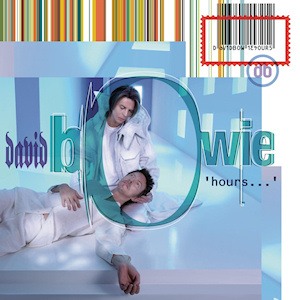
‘Hours…’ by David Bowie

Some might be tempted to assume that I own more Bowie albums than albums by people who aren’t Bowie. That obviously isn’t the case, but his records do pop up on the list with gratifying frequency.

‘Hours’ was his final album of the 20th century, and quite an interesting one in its own way. For the first time in many, many years, it was an album less defined by its style than by its content. This worked in its favour to a degree – it made it harder for the critics to beat it with a stick, and reviews were favourable at the time. On the other hand, it meant that any weaknesses in the album couldn’t be disguised by the underlying concept, something which helped cover the gaps in, say, Outside or Earthling. In place of grand artistic ideals came a set of simple songs, predominantly acoustic, that were to live or die by their own merit. Along with this came a willingness to embrace the past, both on the record itself, and in the live appearances he made around the same time (including a career-rejuvenating Glastonbury headline slot).

Twelve years on, and it’s hard to see ‘Hours’ as much more than a career footnote, especially with the knowledge that ‘Heathen’ was just around the corner. There are some really good moments present: ‘Thursday’s Child’ is a richly textured ballad, ‘What’s Really Happening’ and ‘Something In The Air’ are age-appropriate takes on classic Bowie. ‘The Pretty Things Are Going To Hell’, despite being self-referential to the point of extreme parody, is a great rock track, and ‘Survive’ is up there with his very best tracks – worth owning the album for on its own. Elsewhere, other tracks feel a little underwhelming either in production terms (‘Seven’), or in terms of the material itself. But it’s a perfectly decent album, and a pleasure to hear. If this had been how he bowed out of recording, it would have been a perfectly acceptable swansong – we’re very lucky that he raised his game once again.

Sunday, 27 November 2011

‘Hotel Shampoo’ by Gruff Rhys

This is an interesting one. I stuck it on my birthday list earlier this year to pad out a set of options that was a little too short. It ended up being perhaps my favourite present. I’d vaguely lost interest in the Super Furry Animals a few years ago, so this was very much a ‘hope-for-the-best’ which paid off.

The trouble SFA always had was that they combined genuine pop greatness with a propensity for sloppy messing about. Now, I don’t object to musical messing about, but when it gets in the way of – you know – making music that’s actually good, it can be a little frustrating. Happily, Rhys has reigned in the nonsense here, producing thirteen tracks of classic pop goodness. Few of them pass the three minute mark, so even the lesser tracks don’t outstay their welcome, but I’d happily listen to almost all of them for longer.

It’s a very relaxed album with a very home-made feel. It impressively jumps from the upbeat (‘Sensations In The Dark’, ‘Conversation, Conversation’) to the gentle (the sublime ‘Take A Sentence’). It displays Rhys’ skill with wordplay (‘If We Were Words’) and his knack for Brian Wilson-esque harmony (‘Honey All Over’). It is, in short, a real treat, and the album I would recommend above all others this year.

‘Hot Fuss’ by The Killers


This is where I lose the cool points – by giving Keane’s 2004 debut a better review than The Killers’ debut of the same year. Happily, I do so in the knowledge that there’s way worse to come in the fullness of time.

Is ‘Hot Fuss’ a bad album? No, not at all. Bits of it are good, and the good bits are actually superb. ‘Jenny Was A Friend Of Mine’, ‘Mr Brightside’, ‘Somebody Told Me’ and ‘All These Things That I’ve Done’ would have made an exemplary four-track EP. Add in ‘Smile Like You Mean It’, and the average quality would just about hold. Trouble is, that still only covers five tracks, and the first five at that. From there on in, the album takes a massive turn towards the mediocre. The remaining six tracks are just… there. They’re not awful, but they’re distinctly unmemorable. If they were spaced out a bit, maybe that wouldn’t matter, but they’re not, and it does.

It’s rare for an album to begin with such huge promise and end so far away from fulfilling that promise. I’ve not bought, or even bothered to listen to a Killers album since. But those first five tracks… if only they’d kept it up.

‘Hopes And Fears’ by Keane

When Keane erupted onto the scene in 2004, they aimed to prove two things: that a band of privately educated posh boys could make it in the world of indie, and that they could do so without using guitars. The first of these aims wasn’t really that hard – the music world is far less dependent on the working classes than it would like to think it is, but the second was a fair challenge. Evidently, they were pretty successful in achieving that one as well, however, as ‘Hopes And Fears’ went on to become the most successful album of all time (I’d need to fact check that – but it felt like it probably was).

Listening back to it seven years on, it certainly has its charms. The album roughly divides into two groups. The first group is composed of upbeat sing-along anthems – ‘Somewhere Only We Know’, ‘Bend And Break’, ‘Everybody’s Changing’, ‘Your Eyes Open’, ‘Can’t Stop Now’ and ‘This Is The Last Time’. This group works well. The band undeniably have a good ear for a melody, and how to hook people into one. The second group, the slower ballad, is less successful. ‘We Might As Well Be Strangers’, ‘She Has No Time’and ‘On A Day Like Today’ – none of them are bad, exactly, but they drag a bit. ‘Bedshaped’, the final song of this group, is by far the most successful as it integrates the anthemic feel of the first group. Little wonder it became a fan favourite. Skirting in between these two groups are two other songs – ‘Sunshine’, which is a pleasant, slightly trippy track and ‘Untitled1’ which seems to have little idea what it is, as evidenced by the fact that – obviously – it doesn’t even have a title.

So, as a debut, it hits more often than it misses, and it did excellent business. It’s aged pretty well. Good stuff.